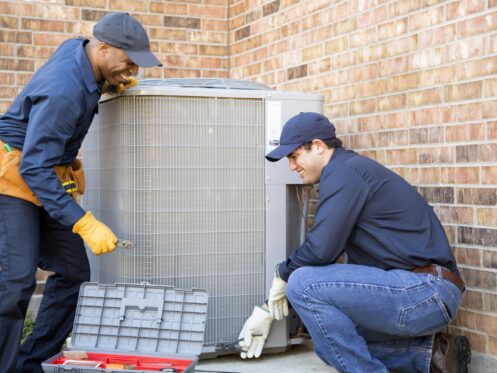
Installing a central AC system is quite complicated and something that should definitely be left to a professional. Even if you’re quite handy and have the right tools and equipment, it’s highly likely that your AC won’t work as well, if it works at all, compared to a professional installation. It also voids the warranty on the system, so you’ll be on the hook for parts and fixed that the warranty would have otherwise covered. Choosing a professional AC company also ensures that your new system will be covered by a manufacturer’s warranty.
If you’re planning to install a new AC in the near future, this article will explain what you can expect from a competent HVAC team and outlines everything you should know about the process.
How Long Does an AC Installation Usually Take?
One thing you surely want to know when planning on an AC installation or replacement is how long the work will take. Many people are quite surprised to learn that either a new installation or an AC “changeout” (replacement) can usually be completed within a single day.
Sometimes, an experienced technician can get everything done in only half a day, but the work could take several days or so in other cases. If your ductwork is old and needs to be replaced as well, you should plan on at least an additional day or two just to remove the existing ductwork and install the new ducts.
How long an AC installation takes also depends on factors like how easy everything is to access and whether the technician encounters any unforeseen issues or has to do any additional work. For instance, it’s not always necessary for the technician to replace the existing refrigerant lines when just doing a changeout, as long as they’re the correct size for the new system and still in good condition.
If the technician does have to replace the line set, the process can easily add at least a few hours to the job. This is especially the case if the indoor part of the system is in the basement and the technician needs to cut out part of the ceiling to run the new lines. Replacing an outdoor AC unit that’s mounted on the roof is also obviously more difficult and time consuming.
Whether you’re installing a split AC system or a packaged system also makes a major difference in how long the job will take. Split systems have both outdoor (the AC condenser) and indoor (the evaporator coil and blower) components and almost always take longer to install. Every component in a packaged system is within a large outdoor unit, eliminating the need to run refrigerant lines between the condenser coil and evaporator coil. Everything in a split system is already connected when it leaves the factory. As such, all the technician needs to do is mount the unit and then connect it to your ductwork system.
Another thing that may surprise you is that a changeout usually takes less time than installing an AC system in a home that doesn’t already have one. One reason is that you need to prep the ground where the outdoor unit is going to sit. This involves leveling the area and then either laying down a composite pad or pouring a concrete pad.
It’s also usually necessary for the technician to make changes to the HVAC air handler in the house or even completely rebuild it so that it can accommodate the evaporator coil. They then need to install and connect the PVC condensate drain lines. The condensate drain system sometimes just runs to a nearby floor drain, but you can also connect it to your plumbing drain system or just run the pipes outside.
An Overview of the AC Installation Process
The process for installing an AC system is fairly straightforward. If you’re having an existing system replaced, the first thing the technician needs to do is drain and reclaim all of the refrigerant from the old system. This is an EPA requirement, meaning it’s illegal to remove an old AC system without first reclaiming the refrigerant. This process normally takes around 30 minutes to an hour, but it can sometimes take several hours.
Once the old system is drained, the technician can then disconnect the refrigerant lines from both the indoor and outdoor coils. The next step is obviously to remove the outdoor unit and the evaporator coil. The technicians will then bring the new equipment in and start hooking it up. This involves using high heat to braze the copper refrigerant lines to each coil. Brazing is also a fairly time-consuming process, and you need to take repeated breaks to allow everything to cool down to ensure nothing gets burned.
The last step is to charge the system with refrigerant and ensure everything is properly calibrated and works as it should. This can involve processes like adjusting the speed of the blower to ensure it moves the correct volume of air. The fact that each home and HVAC system is different means that an AC system is never just ready to go once everything has been hooked up. If the technician doesn’t properly calibrate the system, it likely won’t work as well as it should and could experience major problems like short cycling or increased energy use.
What to Look for When Choosing a New AC
It’s not always easy to decide which new AC system is best, as there are simply so many different options to choose from. The first thing you always need to do is have an HVAC company perform what’s known as a cooling load calculation to determine what size of AC condenser unit you need.
You could just go with the same size as what you currently have, but the issue is that a fairly large number of homes have an AC that’s either undersized or oversized and doesn’t cool as effectively as it should. Trying to determine what size of AC you need is also not something you can accurately do yourself because a cooling load calculation involves many additional factors other than just the square footage of your house.
When choosing a new AC, you also want to make sure that you’re at least somewhat familiar with SEER ratings. The SEER rating of an AC unit tells you how energy efficient it is and allows you to estimate how much energy it will use per year. The main thing to understand is that a unit with a higher SEER rating will cost you less to run. This is why it’s often worth paying more for a unit with a higher SEER rating, as the amount it will save you on your cooling bills will usually cancel out the higher initial cost.
The other thing to decide is whether you want to install a single-stage, two-stage or variable-speed AC. Single-stage ACs cost less, but are also the least efficient option. Two-stage ACs are sort of the middle of the road in terms of cost and energy efficiency. This type of unit has a second power setting, allowing it to reduce its cooling output to save energy.
It can also still run at full power any time it’s much hotter outside or you’re trying to bring the temperature in your home down more. Variable-speed ACs have a huge number of settings that they can automatically switch between to strike the perfect balance between efficiency and cooling output.
As one of the leading HVAC companies in Pensacola, FL, Carnley Services has what it takes to keep you comfortable all year round. We offer expert AC installation services and will make sure your new AC system works for your home and fits in your budget. To learn more about the AC systems we offer or to schedule a maintenance or repair call, contact us today.